
Posts

Thoughts

What else can I do?

If you’re a UK academic working in a university that is planning redundancies, you may understandably be worried about getting another academic job in the sector you’ve worked in all your life.

You may be at sea and wondering what else you could possibly do if you had to leave academia, seeing as ‘all’ you’ve done is ‘just’ be an academic. It’s a key part of your identity. Who would you be without it?

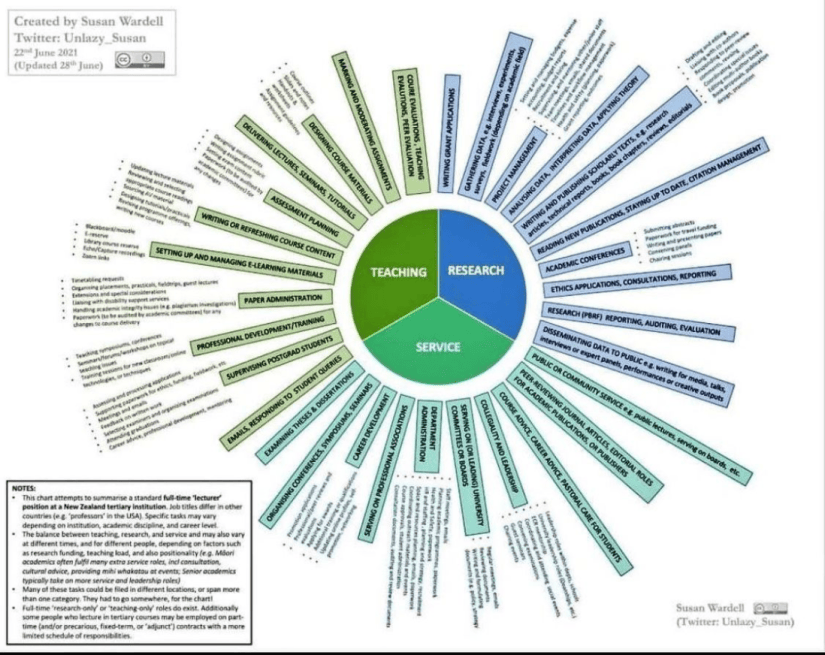
Well, if you actually shine a light on what it is you currently do, it probably looks something like this wonderful graphic that Susan Wardell, a New Zealand academic, created a few years ago: What a lecturer does.
Then, you might consider removing the word ‘just’ from your vocabulary.

If you consider all these experiences and skills and how multitalented you are and think about how these might transfer to many other contexts, give yourself some credit.

You are a highly skilled and experienced individual with so much to offer the world beyond academia. Read that again. Believe it.

I often show this graphic to academics I coach who are pondering a career change and considering what they can do. The sector is good at making people feel small and demoralised. Often in coaching clients like this, some of the coaching can be about re-finding yourself, working with your values, building understanding and confidence in your own abilities again.

Of course it is depressing, anxiety inducing and for some, infuriating, to be ‘forced’ to shift career, especially under the urgency of perhaps having a mortgage to pay etc. But please take some comfort that as an academic you’re probably already doing multiple jobs, as shown in the graphic, and if you’ve been in academia any length of time you’ve had to adapt and adapt again to the latest requirements. You’ve had to be resilient. You are a survivor.

When I chose to leave academia myself in 2017, I didn’t quite know what I’d do. But I found by experimenting that working for myself was right for me. I adapted and built on my skills and learned lots through the process. It was by choice for me, so very different to the current situation, where the emotional as well as practical impacts will benefit from lots of care at such a fragile juncture.

If you are an HR director at a university, are you doing things to support staff at risk of redundancy? Are you offering coaching workshops or 1-2-1 coaching to staff? Or if you’re an academic facing this challenge, are you getting support?

Thoughts

Gender, Language and the Media

‘Ride me to Narnia, bitches’

Last year, I wrote a version of this article below as a LinkedIn post. It was a popular post so I thought I’d add it here as it serves as a good example of sexism in the media purporting to be progressive (yes, a year ago – I’m a bit rubbish at keeping my website up-to-date!).

I wrote this piece in response to Channel Four’s release of a spoof public apology video for their ‘overrepresentation’ of diversity. Interestingly, looking now, the video has had 3 million views on YouTube and just over 700 ‘likes’.

The video promo is fronted by newsreader, Phil Gayle, and begins with him directly speaking to camera in sombre tones while the national anthem is played in the background, before moving on to show clips from an array of C4’s shows.

Gayle, a Black man, is I one of (I think) 3 people in the (roughly 50) representations shown that is over the age of 40ish. The other 2 people are white men who speak and represent the ‘PC gone mad’ critique. Certainly, no women over age 40 speak.

I raise this gendered context because the final line spoken by Gayle is ‘ride me to Narnia, bitches’. It’s meant to be an ‘in yer face’ take it or leave it, this is what we’re about kind of message.

I have a problem with it.

‘Bitch’ is almost exclusively used about women and in a derogatory sense (when it is occasionally directed at men, it is also derogatory). The word is often used as a way of silencing women (‘shut up, bitch’) or of suggesting that the woman says or does nasty things (‘she’s a total bitch’). It’s a sexist term, wherever it is used about people.

Carried over into this promo and used generically for all people, it brings those silencing tones with it – the messaging is ‘shut up bitches’ at the end. Interestingly, when I questioned the use of the word on CEO Alex Mahon’s LinkedIn post promoting the piece, someone swiftly stepped in to tell me to ‘step away from my important and vital perspective’ – a version of ‘shut up (bitch?)’. The promo is an enabler of this behaviour, in my view.

If we imagine another derogatory term usually referring to one group of people carried over in this way, I think it helps to illuminate the problem:

‘Ride me to Narnia, puffs’
‘Ride me to Narnia, cissies’
‘Ride me to Narnia, n*****s’
‘Ride me to Narnia, r**ards’

It’s hard to imagine C4 using any of these in a promo about how fabulous its diverse representation is. The normalisation of sexism is at play here. It’s like wallpaper, so much part of the background that many don’t see it.

I am absolutely all for diverse representation. But that does mean *all* and it does mean not using insulting language at the expense of women.

We know that grey-haired women aren’t cool 😉 We are underrepresented on screen (and in production) and we don’t earn the same as male actors when we are there.

We also know that feminists like me have no sense of humour 😉

Out of interest, I looked up C4’s gender pay gap stats, which tell their own story. The link’s in the comments but headlines are:

* women earned 76p for every £1 that men earned (comparing median hourly pay)
* women made up 49.4% of employees in the highest paid quarter, and 71.5% of employees in the lowest paid quarter
* women’s bonus pay was 21.8% lower than men’s (comparing median bonus pay)

Will look forward to a promo film about this one day.

Thoughts

Spotlight on: Focus groups

I love facilitating focus groups as a method to understand what is going on, whether it be with community groups or with employees or groups of staff.

There is a richness in the qualitative data collected in focus groups or listening sessions that you don’t really get any other way. Your quantitative data – the number crunching – tells you what’s going on, whereas focus groups complement this and help you to understand why it is happening. People’s voices add to the evidence base and help you to plan what to do next. For example, your data from your staff survey might tell you that people aren’t happy about something and you need to find out more detail as to what the problem is. Or, you might want to engage with a community group to understand how your service is landing with them. Focus groups are ideal for these situations.

Facilitation of a focus group requires exercising advanced listening skills and an ability to manage and flex with a group’s dynamics and needs, all while remaining focused (!) on getting answers to the questions you have. Questioning routes are usually semi-structured to allow for this kind of flex.

I always allow a fair bit of time for people to settle in, especially as a lot of the work I do is around ‘sensitive’ topics of diversity and inclusion. It’s important to allow time to build rapport and allow people to feel comfortable with you from the moment they enter the space and in the first couple of ‘warm-up’ questions. You can’t expect people to share what might be personal / challenging for them without creating the environment for that to happen. The facilitator’s engagement with people in those opening moments is key to how the rest of the session will go. The facilitator needs to be fully present, listening, open and non-judgemental, encouraging contributions gently by the attitude of genuine interest that they display.

An external, neutral, facilitator is valuable wherever you need people genuinely to open up. People can input anonymously, as the facilitator’s report or presentation can ensure all themes are captured without identifying people.

If you need some help with consulting with your staff or a community group, get in touch – we can design a strategy that’s right for your context and purpose, helping you get the answers you need.

graphic of two differently sized hands in multiple bright colours
News, Uncategorized

Competition for International Day of the Girl 2020: Free coaching offer!

Do you work or volunteer with girls or young women aged 18 or under?

You might be a mentor, a youth worker or work or volunteer with a girls’ group or organisation – anything that supports girls!

To mark the 25th anniversary of International Day of the Girl this year – 11th October 2020 – I am running a competition to win a programme of 3 x 1 hour FREE coaching sessions with me via Zoom between October and December 2020.

The winner will be drawn at random on Friday 9th October. Entries (open to people aged 18 or over) need to made on this 2 min online form by 5pm (UK time) on 8th October 2020.

What’s this coaching malarkey and how can it help?

I’ll work one-to-one with you and you set the agenda for what you wish to focus on. My coaching does not offer you advice but rather, through questioning techniques, you arrive at your own solutions and decide on actions to take. I bring a confidential, objective, listening ear. And, you get a supportive accountability buddy while you take your actions and make changes!

Developing your potential helps the girls/young women you work with to develop theirs – you’re worth it!

Some examples of what previous clients have worked on:

  • facing a challenge, opportunity or having a decision to make
  • struggling with managing time, confidence or working relationships
  • not sure what direction to go in
  • juggling work and life balance

But the agenda really is yours! For a chance to win, here’s the 2 min online form. Complete it by 5pm (UK time) on 8th October 2020. Entrants must be 18 or over.

International Day of the Girl

This year’s International Day of the Girl theme is ‘My Voice, Our Equal Future’.

This year focuses on girls’ and young women’s demands to:

  • live free from gender-based violence, harmful practices, HIV and AIDS
  • learn new skills towards the futures they choose
  • lead as a generation of social activists accelerating social change

Here are just a couple of statistics that demonstrate why marking International Day of the Girl is needed to draw attention to inequalities and provoke change:

  • Nearly 1 in 4 adolescent girls aged 15-19 globally are not in education, training or employment compared to 1 in 10 boys of the same age.
  • Nearly 4 in 10 adolescent girls globally think wife-beating is justified.
  • 1 in every 20 adolescent girls globally aged 15-19 has experienced rape or forced sex.

These are some of the reasons that if you’re supporting girls in your work or volunteering, I want to support you!

Here’s the short form again.

If you have any questions, get in touch here!

Good luck!

Thoughts

“There’s just so much to worry about”: How coaching can help during the Covid pandemic

What’s going on?

We are all experiencing the global Covid-19 pandemic in different ways. 

Some have experienced the pain of personal illness, loss and grief.  Some face threat or reality of losing a job and along with this the financial anxiety, the worry over what else you might do and perhaps your sense of identity that comes with your position.   

If you are still working, you may well be doing so from home, perhaps juggling your children’s maths / ‘artwork’ / games / tantrums while your cat sits in front of your face on Zoom calls, and the Amazon delivery of your new pyjamas*  arrives just as you are about to present to your team what you have worked on for two weeks (*you don’t need clothes for the outside world– you’re not going anywhere, after all).

Things are mixed up at the moment. They are not in their place – not the way it was ‘supposed’ to go. 

On the other hand, you might have been guiltily enjoying some aspects of lockdown – time finally to watch the final season of Orange is the New Black, for instance (no spoilers – I still haven’t finished it). 

Getting off the proverbial hamster wheel may have given you time to think about whether you are doing work you really enjoy / are interested in or if you fell into it and have stayed – 3, 5, 10 years. But what else could you do? Do you want something else? Maybe it’s promotion, maybe it’s a career change or a better work/life balance?   

How could coaching help?

I’ve certainly noticed an increase in enquiries asking me about coaching throughout the pandemic. 

You might not be sure what coaching is or may have the impression it’s just for senior executives. Here’s a thought: coaching is for anybody who wants to work on making some changes, wants a supportive thinking space, wants to be listened to (when were you last really listened to?!). An objective listening ear can illuminate different perspectives and get you to the place you need to be quicker than you would do yourself.   

You might be dealing with change, wanting to make some changes in your life, to be more confident, to be better at prioritising, manage your time, feel less overwhelmed, need to make a decision…. the list goes on. 

A coach works with you on your agenda, providing a safe, confidential space. They also act as a gentle accountability buddy. If you say you are going to do something to someone else, you tend to do it. So many of us are really good at ignoring ourselves – in fact we excel at it!  Think: gym memberships, healthy eating, that small DIY task etc….      

What’s within your control?

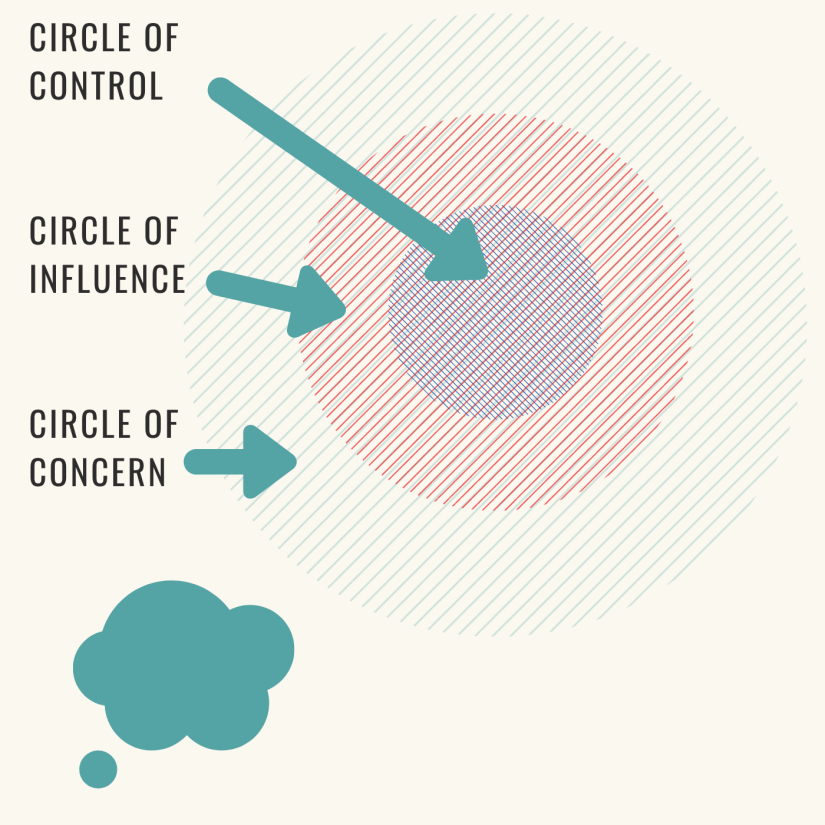
I’ve noticed that in coaching sessions recently I have been drawing a lot on the concept of the circles of control, of influence, and of concern.  There is something timely about this framework, which is adapted from Stephen Covey’s bestselling book, The 7 Habits of Highly Effective People. 

If we spend too much time thinking about things in the outer circle, we can become paralysed as we have no control or influence over these things. Examples of things in the circle of concern are the pandemic or becoming unemployed as a result of the economic downturn. 

Instead, spending time and energy within the spheres of control and influence means we are agents in our lives (you’re not ignoring those areas of concern – you’re acknowledging them and choosing to re-focus). Coaching can help you to define what is within your capacity to influence, what you may wish to, and how to go about it. It can also support you with techniques to ‘park’ those elements out of your control so that you can re-focus and support yourself better.  

Coaches do not have the answers for you (sorry!) – you do. What a coach does is help you elicit what you feel is right for you to do and get started on it. 

So, if you have a challenge at the moment, think about what is within your circles of control and influence. How might you use this framework to support you through one of the most challenging times in a generation?   

This piece was first published on Thrive Global.

Events

Women in Academia Resolutions Retreat, online June 2020

An impact of the Covid-19 pandemic is its challenge to our day-to-day working and living practices.

For many people, this has provoked a reflection on what is truly important, what our personal values are.

Building on a successful Resolutions Retreat for Women in Academia held in ‘real life’ earlier this year, I’m pleased to offer an online version of this retreat.

The aim is to support women in academia to reflect on work and work/life values and consider how to set realistic goals at a time when the space to focus is stretched or maybe feels non-existent.  

Numbers are strictly limited in order to enable plenty of interaction, with lots of reflection and discussion time – and space for coffee breaks!

The Resolutions Retreat: 

  • gives you a space to reflect on your values 
  • takes a values-led approach to deciding priorities and setting realistic goals
  • provides a framework for supporting you stick to your resolutions and achieve your goals

Give yourself an afternoon to focus on you. 

Share the space with other women who understand the particularities (and peculiarities?!) of the academic world. 

Sign up on the Eventbrite page here

If you have any queries about the event, or are wondering if it is right for you, please do get in touch with Julie. You can email her via her website contact form or find her on LinkedIn or Twitter

Feedback on the previous (in person) Resolutions Retreat:

 The space:

“Time for reflection and re-evaluation”

“A quiet, respectful space”

“There was openness and mutual respect”

The takeaways:

“It has consolidated ideas and next steps”

“Really enabled a clear thought direction”

“Enabled me to re-set goals and resolutions”

“It has helped me focus in terms of my direction, but also why I find certain things/issues important”

“It gave a framework for thinking/reflecting”

“It has made me see the mismatch between values and goals and made me think about how to create space for the values”

“It has really made me understand/see why I am struggling to ‘fit’ in both with the institution where I work and academia. I’ve realised this is because of the dissonance between my values and goals”

The shared experience:

“One of the best things was hearing other women discuss their experiences and goals”

“It helped me realise I am not alone in these difficulties”

The facilitator:

“It was run in a thoughtful and peaceful way”

“Julie is a skilled and enabling facilitator”

 The only suggestion for improvement was that people wanted more…..! 

Testimonial: 

“Julie fostered a very safe atmosphere of positivity during the ‘Resolutions Retreat’ I attended, and she really helped me to think about my goals, aspirations, and why this is my career. The conversations were lively but incredibly respectful – not always something I’m used to at work. It was really important to get together with like-minded women, of different ages, experience, and backgrounds, and really heartening to know we often share similar stories. I was especially interested in the match or mismatch with an ‘institutional message’, and how to navigate that in terms of my own ethics. The most important thing though, was that Julie helped us all explore different perspectives, and learn new things about ourselves.”

And do take a look at this blog for some thoughts behind putting on the first resolutions retreat in January 2020.  

Thoughts

Why a Resolutions Retreat for Women in Academia?

This week Times Higher Education published an interesting article covering The University of Glasgow’s welcome decision to make ‘collegiality’ an explicit requirement in its internal professorial promotions criteria. Examples given include recommending a colleague for an award, or crediting them as Co-Investigator on a major research project.

The image THE chose to accompany this positive news – an image of men helping other men over a wall – is somewhat ironic if you’re a woman in the academic world. For, one could be forgiven for reading statistics on the overrepresentation of men in senior academic and managerial positions as evidence of the fact that academia is already working efficiently in supporting men’s collegiality with one another.

I was motivated to offer my first Women in Academia Resolutions Retreat, coming up in January 2020, to support women to take some time out to focus on themselves. It’s important to continue to challenge the imperfect structures of academia, while at the same time to work on how we can support ourselves within those imperfect structures. Anecdotes, academic research and personal experience demonstrate that women can be notoriously bad at prioritising ourselves. Some men experience this, too, of course, and they are the ones doing the ‘housework’ of the department alongside the women.

Housework might take the form of being the (implicitly-) understood ‘go to’ person for students for support, being the person always assigned programme leadership, teaching introductory core modules or given administrative tasks etc. It’s a real skill – and indeed a compliment – being the ‘safe pair of hands’ who can hold that ticking grenade safely. But holding that grenade comes at a cost – you are likely holding it for someone else whilst they are getting on with the things they want to do.

While you’re holding the grenade for someone else, it’s very easy to lose sight of what you want to achieve. After all, if you lose focus, you will drop the grenade and it will, you feel, be catastrophic for everyone!

boom-2028563_1280.png

So, how exactly do you focus on you instead? It’s key to take some time out to reflect on where YOU want to go.

First – put down the grenade (psst – it’s not actually a grenade and it’ll be OK!!)

Now you’re more relaxed, consider what you would like to achieve and what steps you need to take logically in order to get there. It could be that you already know what you want to achieve – great!  But it could be that you need to sit back and think about what is important to you. What’s important to you aligns with your values. If you set goals in line with your values, you are going to be more motivated and likely to achieve those goals.

To use myself as an example, once I realised I was working to an agenda that was not my own in a previous situation, I had a proverbial light-bulb moment: “it’s not my goal- I’m not motivated by it”. Without realising it, I hadn’t been realistically working toward that goal; instead, I’d been procrastinating and finding distractions. It was because I was not only not bothered about achieving it but actually felt it would be pretty worthless, judged by my own value system. It was a tough lesson as I had spent many years not realising this! But I re-set things and took steps toward what I actually wanted to achieve.

We all have contexts in which we work and things we need to do that we might prefer not to (for me now I’m self-employed, that’s my accounts!). But there are ways to work within our realities.

My goal for the Resolutions Retreat is that participants leave with a clearer idea of their goals, how to achieve them and with the resolve to take action.