Thoughts

“There’s just so much to worry about”: How coaching can help during the Covid pandemic

What’s going on?

We are all experiencing the global Covid-19 pandemic in different ways. 

Some have experienced the pain of personal illness, loss and grief.  Some face threat or reality of losing a job and along with this the financial anxiety, the worry over what else you might do and perhaps your sense of identity that comes with your position.   

If you are still working, you may well be doing so from home, perhaps juggling your children’s maths / ‘artwork’ / games / tantrums while your cat sits in front of your face on Zoom calls, and the Amazon delivery of your new pyjamas*  arrives just as you are about to present to your team what you have worked on for two weeks (*you don’t need clothes for the outside world– you’re not going anywhere, after all).

Things are mixed up at the moment. They are not in their place – not the way it was ‘supposed’ to go. 

On the other hand, you might have been guiltily enjoying some aspects of lockdown – time finally to watch the final season of Orange is the New Black, for instance (no spoilers – I still haven’t finished it). 

Getting off the proverbial hamster wheel may have given you time to think about whether you are doing work you really enjoy / are interested in or if you fell into it and have stayed – 3, 5, 10 years. But what else could you do? Do you want something else? Maybe it’s promotion, maybe it’s a career change or a better work/life balance?   

How could coaching help?

I’ve certainly noticed an increase in enquiries asking me about coaching throughout the pandemic. 

You might not be sure what coaching is or may have the impression it’s just for senior executives. Here’s a thought: coaching is for anybody who wants to work on making some changes, wants a supportive thinking space, wants to be listened to (when were you last really listened to?!). An objective listening ear can illuminate different perspectives and get you to the place you need to be quicker than you would do yourself.   

You might be dealing with change, wanting to make some changes in your life, to be more confident, to be better at prioritising, manage your time, feel less overwhelmed, need to make a decision…. the list goes on. 

A coach works with you on your agenda, providing a safe, confidential space. They also act as a gentle accountability buddy. If you say you are going to do something to someone else, you tend to do it. So many of us are really good at ignoring ourselves – in fact we excel at it!  Think: gym memberships, healthy eating, that small DIY task etc….      

What’s within your control?

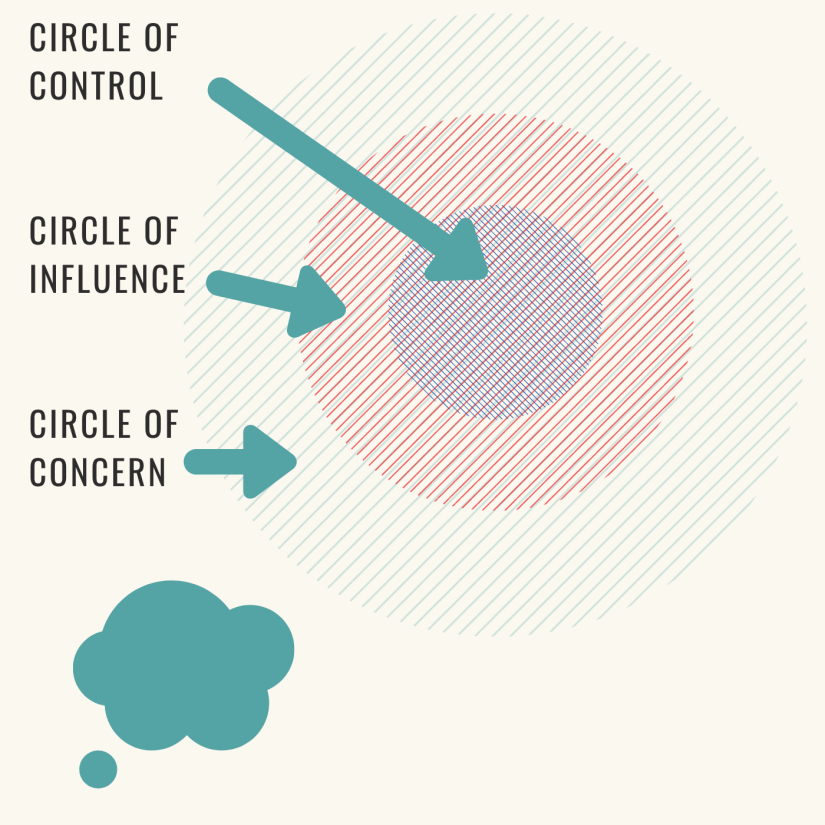
I’ve noticed that in coaching sessions recently I have been drawing a lot on the concept of the circles of control, of influence, and of concern.  There is something timely about this framework, which is adapted from Stephen Covey’s bestselling book, The 7 Habits of Highly Effective People

If we spend too much time thinking about things in the outer circle, we can become paralysed as we have no control or influence over these things. Examples of things in the circle of concern are the pandemic or becoming unemployed as a result of the economic downturn. 

Instead, spending time and energy within the spheres of control and influence means we are agents in our lives (you’re not ignoring those areas of concern – you’re acknowledging them and choosing to re-focus). Coaching can help you to define what is within your capacity to influence, what you may wish to, and how to go about it. It can also support you with techniques to ‘park’ those elements out of your control so that you can re-focus and support yourself better.  

Coaches do not have the answers for you (sorry!) – you do. What a coach does is help you elicit what you feel is right for you to do and get started on it. 

So, if you have a challenge at the moment, think about what is within your circles of control and influence. How might you use this framework to support you through one of the most challenging times in a generation?   

This piece was first published on Thrive Global.

Thoughts

Why a Resolutions Retreat for Women in Academia?

This week Times Higher Education published an interesting article covering The University of Glasgow’s welcome decision to make ‘collegiality’ an explicit requirement in its internal professorial promotions criteria. Examples given include recommending a colleague for an award, or crediting them as Co-Investigator on a major research project.

The image THE chose to accompany this positive news – an image of men helping other men over a wall – is somewhat ironic if you’re a woman in the academic world. For, one could be forgiven for reading statistics on the overrepresentation of men in senior academic and managerial positions as evidence of the fact that academia is already working efficiently in supporting men’s collegiality with one another.

I was motivated to offer my first Women in Academia Resolutions Retreat, coming up in January 2020, to support women to take some time out to focus on themselves. It’s important to continue to challenge the imperfect structures of academia, while at the same time to work on how we can support ourselves within those imperfect structures. Anecdotes, academic research and personal experience demonstrate that women can be notoriously bad at prioritising ourselves. Some men experience this, too, of course, and they are the ones doing the ‘housework’ of the department alongside the women.

Housework might take the form of being the (implicitly-) understood ‘go to’ person for students for support, being the person always assigned programme leadership, teaching introductory core modules or given administrative tasks etc. It’s a real skill – and indeed a compliment – being the ‘safe pair of hands’ who can hold that ticking grenade safely. But holding that grenade comes at a cost – you are likely holding it for someone else whilst they are getting on with the things they want to do.

While you’re holding the grenade for someone else, it’s very easy to lose sight of what you want to achieve. After all, if you lose focus, you will drop the grenade and it will, you feel, be catastrophic for everyone!

boom-2028563_1280.png

So, how exactly do you focus on you instead? It’s key to take some time out to reflect on where YOU want to go.

First – put down the grenade (psst – it’s not actually a grenade and it’ll be OK!!)

Now you’re more relaxed, consider what you would like to achieve and what steps you need to take logically in order to get there. It could be that you already know what you want to achieve – great!  But it could be that you need to sit back and think about what is important to you. What’s important to you aligns with your values. If you set goals in line with your values, you are going to be more motivated and likely to achieve those goals.

To use myself as an example, once I realised I was working to an agenda that was not my own in a previous situation, I had a proverbial light-bulb moment: “it’s not my goal- I’m not motivated by it”. Without realising it, I hadn’t been realistically working toward that goal; instead, I’d been procrastinating and finding distractions. It was because I was not only not bothered about achieving it but actually felt it would be pretty worthless, judged by my own value system. It was a tough lesson as I had spent many years not realising this! But I re-set things and took steps toward what I actually wanted to achieve.

We all have contexts in which we work and things we need to do that we might prefer not to (for me now I’m self-employed, that’s my accounts!). But there are ways to work within our realities.

My goal for the Resolutions Retreat is that participants leave with a clearer idea of their goals, how to achieve them and with the resolve to take action.


large lily pads on water giving impression of stepping stones
Thoughts

Career change beyond the Academy

I was pleased to contribute a blog post on my career change story for my former university, University of Sheffield. They run a fantastic blog series on careers beyond the academy for post PhD students. It can be hard to know how to transfer your skills and what use value a PhD has in the wider world. The v i s t a blog helps people see what’s possible through live examples! Check out my contribution here.

Read more about my thoughts on leaving academia and feeling ‘free’ here.

a pair of spectacles resting on an open book
Thoughts

Gender pay gap: a bifocal approach

As businesses employing over 250 staff are scrambling to publish their gender pay gap data before the deadline of midnight tonight, findings thus far are looking stark, though frankly unsurprising.

In the public sector, where the deadline was last Friday, figures reveal that organisations such as councils, the NHS and universities pay women on average 14% less than men. There is no expectation that private sector organisations will perform any better.

I have seen a range of responses to the emerging data which traverse from:

  • Outright denial: there is no such thing as a pay gap as the Equal Pay Act makes it illegal and ensures equal pay for equal work;
  • Data quibbling: the data only records the median and mean, not the types of jobs people are in or the full-time/part-time divide – thus the data is dismissed as meaningless;
  • Welcoming the data as a snapshot and a call to action.

Outright Denial

Yes, we have an Equal Pay Act. Equal pay for equal work and has been a legal requirement since 1970. However:

(a) Because something is illegal does not mean it does not occur. No-one would say there is no such thing as burglary because it is illegal. A small proportion of the data currently being reported will almost certainly be due to unequal pay for unequal work. ConHandritten labels 'ILLEGAL' and 'LEGAL' being placed next to one another with a thumb and finger just visiblefidentiality around salaries makes for a culture where this can occur.

(b) Equal pay is not the same as the gender pay gap. The gender pay gap is the difference in earnings between men and women overall within an organisation. The current data being collected records the median and mean of women’s salaries and men’s salaries.  Thus, women might be in different roles to men or in more part-time roles and the median and mean will capture the overall discrepancy in salaries encapsulating this difference.

Data Quibbling

It is true that recording the median and mean has its disadvantages in that it does not demonstrate the nuances of discrimination operating within an organisation. Nevertheless, to dismiss the data as meaningless is an easy way to dismiss dealing with the discrimination that is clear from these initial figures. What the average shows is an overall difference difference between the pay of women and men and it requires us to ask questions as to why women are persistently paid less than men in organisations. Why is it that the styles of working and the types of roles women tend to adopt do not offer equal renumeration with the styles and working and the types of roles that men tend to adopt?

woman with small child

There are a range of reasons women may work differently to men, none of them, I would argue, down to unhindered ‘choice’.  Significantly, the lion’s share of (unpaid) housework and (unpaid) childcare falls to women, emerging from cultural expectations. Therefore, it is unsurprising that women may not be able to put in a 70 hour week, or even a 37 hour week, at work because they are already working maybe 20 hours unpaid at home.  No wonder, then, that a part-time role appears more appealing or a promotion requiring unpaid overtime seems out of reach.

Data quibblers also sometimes like to point out that women go into relatively low paid ‘nurturing’ careers such as teaching/nursing, thus blaming women for their own situation. The real question here is why are these so-called nurturing professions paid less in the first place?  Indeed, there is research that demonstrates that when more women enter a profession, the remuneration for that profession drops, suggesting the status of a profession falls when associated with women.

A Call to Action

It is great that the government has made it compulsory for larger organisations to publish their gender pay gap statistics. The first step is recognising the issue; the real work comes in addressing it. Out of this exercise, each organisation will have data upon which to focus their attention and this publication  from the Government Equalities Office and CIPD gives advice on how to start taking action.

The gender pay gap illuminates gender bias in the way an organisation is structured, its everyday culture and systems. Organisations can operate as magnifiers or minimisers of gender inequity in society at large. As well as considering the larger points of structural discrimination such as promotion criteria and processes, language in job advertisements, structural and unconscious bias, people often don’t reflect on the apparently small elements of the culture of their organisation in gendered terms.

formal photographic portrait of young woman smiling, wearing a hijab

For example, business breakfast meetings or breakfast networking events are becoming more and more the norm. Think about who is often responsible for the school run and who you might therefore be preventing from attending that 8AM meeting – women! When this happens repeatedly, this woman has fewer chances to connect with colleagues than her male peers, leading to fewer opportunities, and, down the line, she may have less on her CV when it comes to promotion rounds.

However, it’s not just mothers that are affected but all women. For instance, a gender pay gap opens up between graduates within as little as one year of graduating from the same degree programme and increases steadily year on year. This all contributes to the gender pay gap.

A Bifocal Approach

Jen de Vries has suggested that organisations need to take a ‘bifocal approach’ to address gender inequalities. The term is effective: it clarifies that organisations need to take both a short-term and longer-term view in bringing about change.  Short term interventions assist women to reach their potential within systems that are not currently offering them equal opportunities.

woman looking through a telescope at a city landscapeHere, we might think of women’s leadership programmes or coaching programmes for women, women’s networks and mentoring. These are valuable interventions. However, they do not tackle the roots of the problems: structural inequalities.

Addressing structural inequalities takes the long-term view and is where real change can occur. This requires changing ways of working to eradicate discrimination in the first place so the women do not require additional support to navigate the organisation’s systems. Examples might include rethinking the organisation’s criteria for leadership and promotion or re-evaluating value and remuneration attached to different kinds of work.

Now that large organisations have a clearer view of their gender pay gap, it’s time to clean the lenses on the bifocals and get to work!

flock of birds flying from a disused pier over water in low sunlight
Thoughts

Free

Free

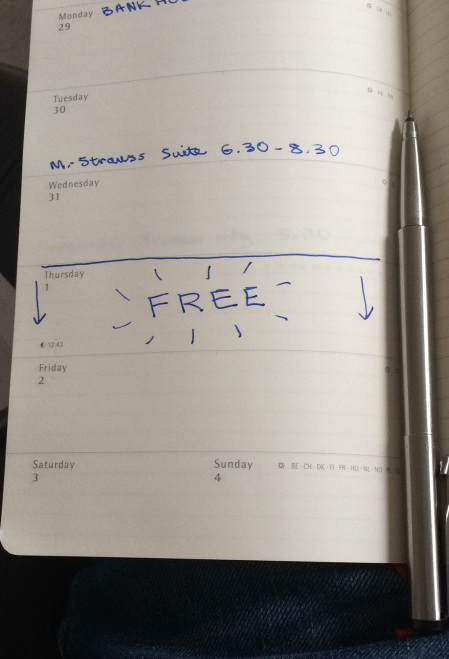
This was my diary entry for my first day as a non-academic. It was in my diary from the moment I heard my request for voluntary redundancy from my employer of twelve years had been accepted.

The simple graphic makes me smile. I love the way the arrows indicate I will be ‘free’ for the rest of my life (!) precisely from 1st June 2017, that I have literally drawn a line to mark the end/beginning and that the freedom glows from the page!

The word ‘free’ had come to take on significant resonance for me following an earlier  coaching conversation. I was receiving coaching as part of thinking through a career change, and without much of an idea what I wanted to do. The coach asked me this incisive question: ‘What would it feel like if you weren’t working as an academic?’ After a short reflection, my response was: ‘I would be free’.

My use of that word for the first time hit me powerfully, the implication being that at that moment I felt the opposite – trapped? – held back? – in chains?!! It all sounds rather dramatic!

Yet, the realisation I was ‘doing the wrong thing’ career-wise had hit me like a bolt one random evening a few months previously. It literally formed as a sentence that I said out loud to myself: ‘I am doing the wrong thing’. The suddenness of it came as a surprise and was somewhat overwhelming, yet the steady erosion of my sense of satisfaction with my choice of career had been working away for many years.

Thinking through a career change can be a huge, daunting task. Then at the age of 46, I felt I was young enough to make a shift but old enough to get cracking on with it! If I had wobbles about leaving academia, and of course I did, I would say to myself – ‘Julie, another 20 years’. The thought of another 20 years doing the same job felt unbearable; I knew that whatever I ended up doing, it would be better for my mental, physical and emotional health than staying put.

Careers are bound up intimately with our identities and status. On social occasions, when people meet for the first time, one of the initial questions is ‘What do you do?’ I had a relatively high status job which was reasonably secure and with a good salary. I also had some absolutely brilliant colleagues with whom I loved working. Academia had offered me so many privileges and opportunities, to research and to teach what I enjoyed.

However, I decided to leave, a move which was either bold or bonkers, or quite possibly both! The strength of needing to do something more in line with my values was what propelled me. I was keen to work where I could have more of a direct impact on social justice. I also needed to be ‘freer’ than the restrictions of working in a huge organisation such as a university permitted. I realised I could pursue my interests beyond the confines of academia more than within it.

So, I took small steps to open myself up to new experiences and to looking at things differently. I became (and still am) a trustee and volunteer with two amazing charities that support and develop women and girls:West End Women and Girls Centre, Newcastle, and Team Kenya CIO. I knew that I would need support thinking through the process of a career change so I had some coaching and also signed up for an online course in changing careers. I took a coaching qualification to broaden my skills. It was hard fitting all this in while still in a busy full-time job; however, I made time because it was so important to me. It was the difference between freedom and constraint after all!

IMG_1643

Now that I am starting up as self-employed, I feel excited and scared at the same time. But mostly I feel thrilled that I can create my own job and do what I really want to do – make a difference, I hope, with regard to gender and LGBT equality and help people realise their own potential through coaching.

In a ‘truth is stranger than fiction’ moment, the final seminar I taught at university was on Samuel Beckett’s Endgame (on a core literature module not designed purposefully by me!). The play is an experimental drama, part of a movement known as Theatre of the Absurd. As the name suggests, Endgame offers a reflection on endings.  It is a dark comedy dealing with, amongst other things, themes of entrapment and circularity. Its opening words are spoken by the character Clov:

‘Finished, it’s finished, nearly finished, it must be nearly finished. [Pause]. Grain upon grain, one by one, and one day, suddenly, there’s a heap, a little heap, the impossible heap. [Pause]. I can’t be punished any more.’

While students in the group wondered if finishing the module on this text was a ‘lecturer’s joke’, I had to wonder what kind of joke it was on me! To finish a career teaching in various English Literature Departments on such a literalised symbolic moment was ‘absurd’ in itself.

What I know now, writing this piece several months after leaving, is that I have grown enormously. I still have my academic colleagues and friends and we are finding ways of working together while I have the added bonus of meeting and working with colleagues in new fields. I am so enjoying the learning and challenge of setting myself up as self-employed. I have done things over the last couple of years I would not have thought possible and I am absolutely looking forward to doing more that I don’t even know about yet!

And yes, I feel free!


Check out an update I wrote one year on in January 2019 on life beyond academia for Sheffield University’s v i s t a blog series here.

If the path before you is clear, you're probably on someone else's. 
Carl Jung